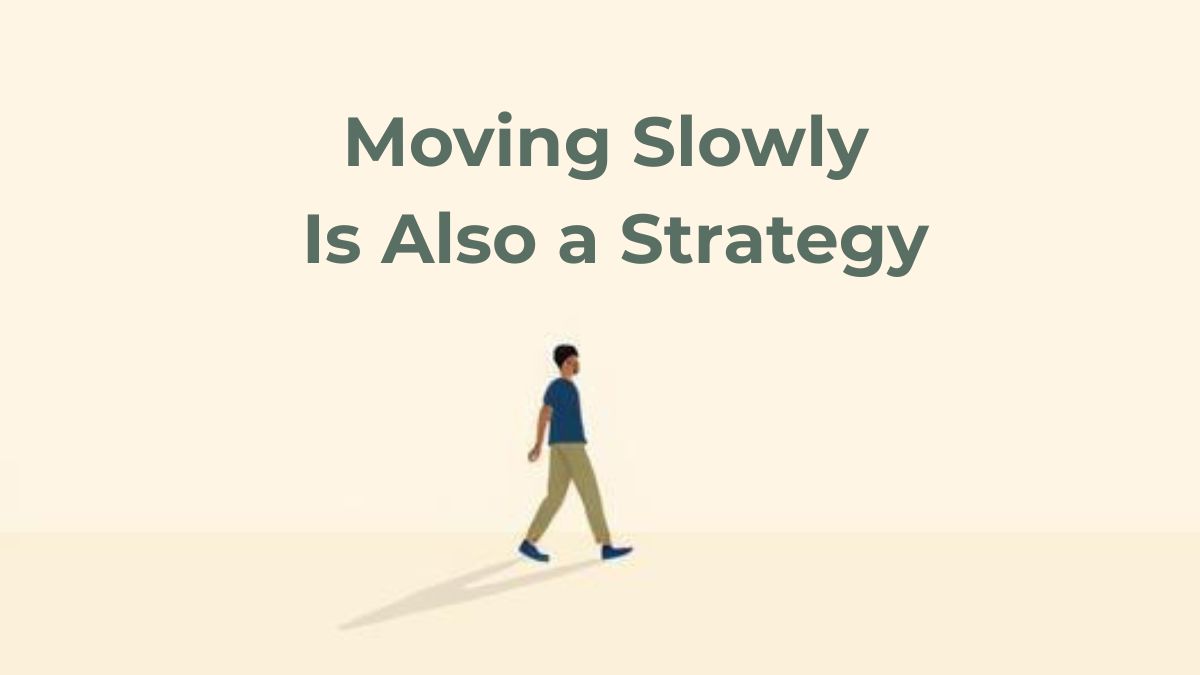
When there is no clear strategy, even moving fast becomes a form of exhaustion. You do many things, but you fail to build anything solid. With a defined direction, however, a slow marketing strategy stops being a weakness and becomes a real advantage.
A slow approach works best when you focus on consistency in digital marketing instead of intensity.
The problem is not moving slowly in marketing, it’s not knowing where you’re going
For a long time, marketers have treated moving slowly as a mistake.
However, the real problem is usually not the pace, but the lack of direction.
That’s why, before asking yourself whether you’re moving too slowly, it’s worth facing a more uncomfortable question:
are you moving toward something specific, or simply reacting?
The confusion between progress and intensity
One of the most common mistakes in digital marketing is confusing progress with intensity.
People often assume that doing more leads to faster progress. Experience, however, shows the opposite.
Intensity can produce short-term results, but it is rarely sustainable. Moreover, when everything depends on bursts of energy, the system eventually breaks down. What looks like commitment today often turns into exhaustion tomorrow.
That is why moving slowly in marketing does not mean doing less out of a lack of ambition, but doing less so you can keep going for a longer time.
When “doing more” stops working
This pattern becomes clear when you examine why poorly designed systems make digital marketing exhausting.
There comes a point where adding more tasks does not improve results.
In fact, in many cases, the opposite happens.
Teams publish more content, but with less clarity.
At the same time, they open more channels, but without focus.
In addition, they test more strategies, yet none of them truly take root.
In that context, moving more slowly is not only reasonable — it is necessary.
Slow marketing strategy as a strategic decision
Moving slowly is rarely an external imposition.
In most cases, it is a conscious strategic decision.
You choose to:
- reduce friction
- eliminate what is non-essential
- prioritize what truly adds value
As a result, progress begins with less noise and greater coherence.
From the outside, it may seem like nothing is happening.
From the inside, however, you build something far more stable.
Sustainability as a competitive advantage

In marketing, almost anyone can move fast for a while.
What truly makes the difference is who can keep going.
Sustainability has quietly become a competitive advantage. While others burn out, change direction, or disappear, those who choose a slow marketing strategy remain present—refining, improving, and accumulating experience.
And over time, that shows.
In fact, various analyses on professional sustainability have pointed out that burnout usually does not come from the work itself, but from poorly designed systems and unrealistic expectations sustained over time.
Fewer decisions, more continuity in a slow marketing strategy
A sustainable system reduces mental load.
Teams make many decisions in advance: what to publish, where, how often, and with what goal.
Thanks to this, marketing stops depending on mood.
Marketing continues even in difficult weeks, precisely because it does not require heroics.
Why a slow marketing strategy does not mean stagnation
There is a common belief that moving slowly means falling behind.
However, stagnation does not come from pace, but from a lack of learning.
When you move slowly, but with attention, you observe more.
You understand the data better.
You make adjustments with intention.
As a result, each small step has more impact than ten impulsive moves.
The long term is not built in a hurry
Marketing that truly works rarely follows trends or shortcuts. A slow marketing strategy may not look spectacular at first, but it delivers consistency over time.
But precisely for that reason, it works.
Sustained habits build the long term, not bursts of activity. And those habits are only possible when the chosen pace is compatible with real life.
For this reason, moving slowly in marketing is also a strategy—one that prioritizes continuity over urgency.
The question that defines your real strategy
Before closing, it is worth pausing for a moment and asking yourself this:
What version of your marketing could you sustain over the next 12 months without burning out?
That answer, even if it is not perfect, is your real strategy.
Everything else is an idealization that will eventually break.
This perspective is part of a broader approach to sustainable digital marketing explained in this guide on consistency in digital marketing.
Conclusion
Adopting a slow marketing strategy is not about giving up on growth.
It is about choosing to grow in a way you can sustain.
In an environment where almost everyone is rushing, those who know how to regulate their pace gain an unexpected advantage. Because when others stop, you keep moving forward.
And in marketing, that changes everything.
If you want to apply this mindset in a structured way, read this sustainable digital marketing strategy guide.