In practice, most marketers don’t fail because they lack tools, effort, or ideas. Instead, they fail because they struggle to make better marketing decisions. In today’s digital environment, full of noise, tactics, and constant pressure to act fast, it’s easy to confuse activity with progress. For this reason, this article explores how to move from reactive execution to intentional strategy — and how better decisions become the real competitive advantage in marketing.
Why Better Marketing Decisions Matter More Than Ever
At the same time, digital marketing has never been more accessible — or more overwhelming. Every week, new platforms, new tactics, and new “must-try” strategies appear. While this abundance creates opportunity, it also increases decision fatigue.
So, the ability to make better marketing decisions is no longer a soft skill. It’s a core strategic advantage.
Research on decision-making under uncertainty shows that clarity and time significantly improve judgment in complex environments.
The real cost of poor marketing decisions
At first glance, poor decisions don’t always look dramatic. More often, they appear as:
- fragmented efforts
- half-finished initiatives
- constant switching between tactics
- short bursts of motivation followed by stagnation
Over time, these patterns quietly drain momentum, clarity, and confidence — making it harder to make progress without burning out.
Why speed often replaces thinking
At the same time, modern marketing rewards visibility and immediacy. And, as a result, many decisions are made under pressure — not reflection. So, acting quickly feels productive, but speed without direction often leads to noise rather than results.
The Difference Between Tactics and Strategy in Better Marketing Decisions
Of course, understanding this distinction is foundational.
Tactics create motion, not direction
In short, tactics are actions:
- publishing a post
- running an ad
- launching a campaign
- optimizing a page
They matter — but without a guiding strategy, tactics become disconnected efforts chasing short-term signals.
Strategy defines what not to do
Strategy is subtraction as much as action. It clarifies:
- where to focus
- what to ignore
- what deserves time and patience
Better marketing decisions emerge when strategy precedes tactics, not the other way around — a shift that favors consistency over intensity.
Why Most Marketers Struggle to Make Better Marketing Decisions
In reality, the issue is rarely a lack of knowledge.
Information overload and tool-driven thinking
Unfortunately, marketing education often focuses on how to execute, not how to decide. Tools multiply, dashboards expand, and metrics accumulate — but decision quality doesn’t automatically improve.
Pressure, urgency, and comparison
Seeing others move faster or publish more creates artificial urgency. Decisions become reactive, shaped by comparison instead of context — a pattern that disappears when clarity replaces speed and clarity over hustle becomes the guiding principle.
This is where many marketers lose strategic control.
A Simple Framework for Better Marketing Decisions
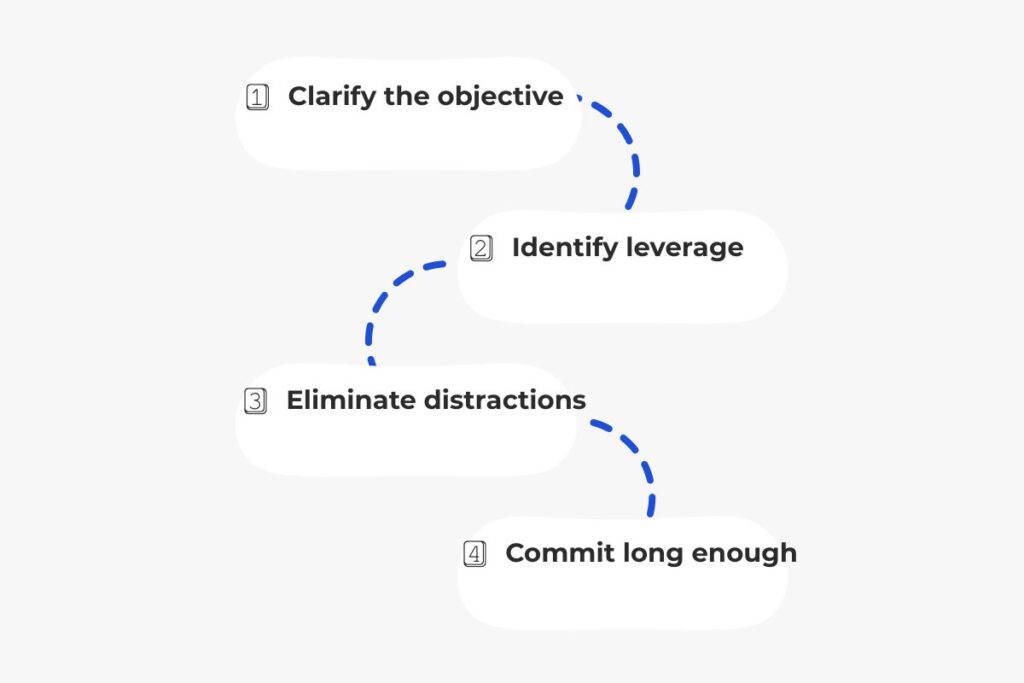
You don’t need complex models. You need clarity and restraint.
Step 1 — Clarify the real objective
Ask:
- What outcome actually matters?
- What does success look like in 3–6 months?
Without this, every tactic feels equally important — and none truly are.
Step 2 — Identify leverage points
In essence, better marketing decisions focus on actions that:
- compound over time
- strengthen positioning
- improve systems, not just outputs
Step 3 — Eliminate non-essential actions
Progress accelerates when you remove distractions. Elimination creates focus, and focus creates momentum.
Step 4 — Commit long enough to evaluate
Over time, constant switching prevents learning. As a result, strategy requires staying long enough to see cause and effect — a reminder that slower acting leads to better decisions, not fewer results.
Moving From Tactics to Strategy for Better Marketing Decisions
This shift doesn’t require doing more. It requires doing less — better.
Fewer actions, clearer outcomes
When decisions are intentional:
- content aligns with positioning
- messaging becomes coherent
- effort compounds instead of resets
Slower execution, stronger positioning
In practice, slower doesn’t mean passive. It means deliberate. Strategic patience allows insight to surface and systems to stabilize — proof that moving slowly is also a strategy, not a lack of ambition.
How Better Marketing Decisions Lead to Sustainable Growth
The benefits extend beyond metrics.
Consistency beats intensity
Sustainable progress is built through repeatable decisions, not bursts of effort. Therefore, consistency creates trust — with audiences and with yourself.
Progress without burnout
When decisions align with strategy, energy is preserved. Marketing becomes a process, not a performance.
Final Thoughts: Better Marketing Decisions Build Better Marketing Systems
Ultimately, marketing success isn’t determined by how much you do — but by how well you decide.
Better marketing decisions create alignment, reduce noise, and turn effort into progress. Moving from tactics to strategy isn’t a dramatic pivot. It’s a quiet shift in how you choose what deserves your time.
This approach becomes even more powerful when applied within a sustainable digital marketing strategy, where these ideas come together into a clear, simple, and consistent system.
Over time, that shift is supported by clearer systems, strategic thinking, and personal clarity. If you want to explore these ideas further and work on both marketing strategy and decision-making foundations, the Academy brings these elements together.